
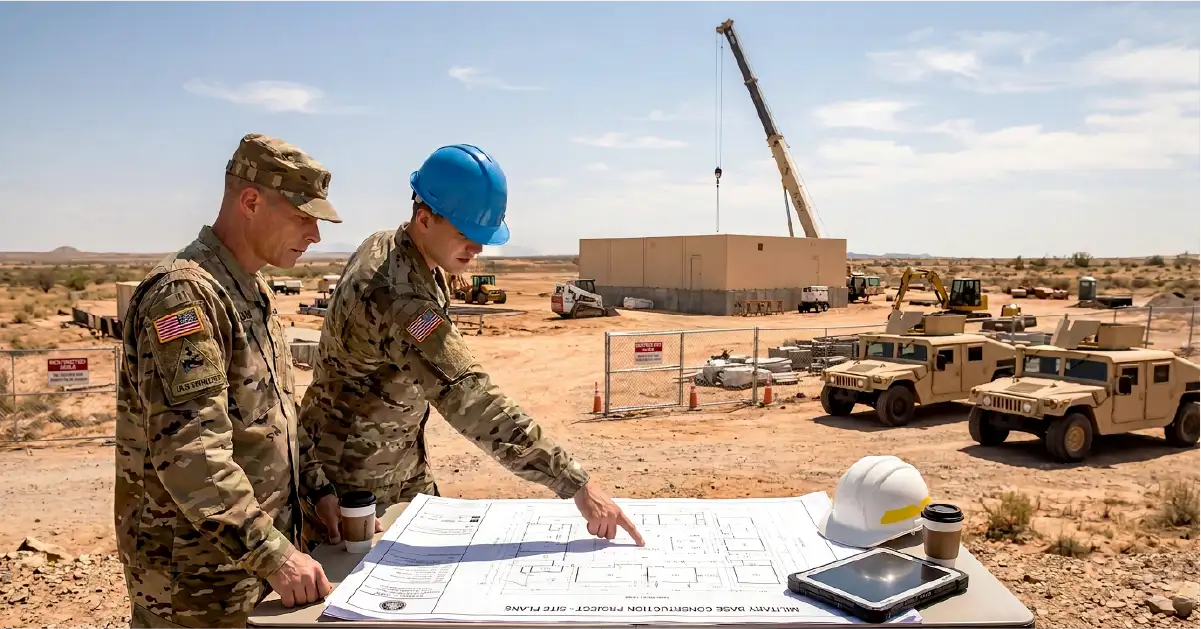
A hardened modular facility destined for a military installation in New Mexico faces a different journey than one bound for a base in Saudi Arabia. One may travel by truck over established highways, while the other must navigate international shipping, customs, and inland transportation before reaching its installation site. Once there, differences in climate, infrastructure, and available construction resources introduce additional considerations. Yet both facilities must meet the protective and operational requirements of their respective missions.
These differences shape how engineers approach CONUS (Continental United States) and OCONUS (Outside the Continental United States) projects. In military usage, CONUS encompasses the 48 contiguous states, and the District of Columbia. OCONUS includes Alaska, Hawaii, US territories, and foreign locations. Transportation restrictions, environmental conditions, site accessibility, and installation logistics must be considered alongside structural design and security requirements, often long before fabrication begins.
CoverSix has supported hardened modular projects across the United States, the Middle East, Europe, Central America, and Africa. This experience reinforces the importance of designing hardened modular facilities for both the customer's mission and the destination's requirements.
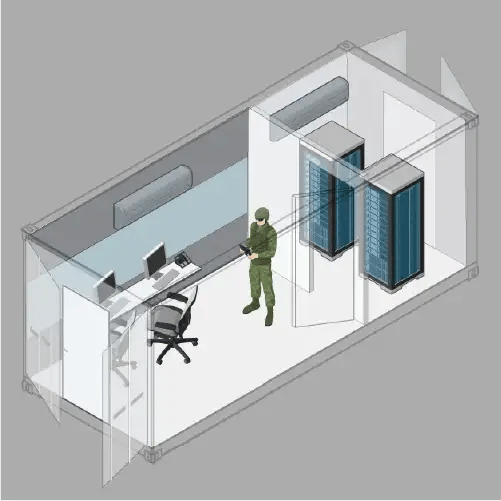 Whether a hardened modular facility is deployed in a CONUS or OCONUS location, its protective requirements begin with the mission it must support and the threats it may encounter. A guard post controlling access to a secure installation has different functional and security requirements than a blast-resistant control room or a Sensitive Compartmented Information Facility (SCIF). Those distinctions influence structural design, materials, building systems, and interior configurations.
Protective specifications may address blast loads, ballistic threats, forced entry, or a combination of hazards. For military and federal projects, applicable requirements can include Unified Facilities Criteria (UFC), agency-specific standards, and project-defined performance criteria. Facilities handling classified information may also require specialized construction, access controls, and communications protections. SCIF projects require coordination with the responsible accrediting official to establish applicable Intelligence Community Directive (ICD) 705 requirements and TEMPEST countermeasures for controlling compromising emanations. These requirements must be established early because they affect wall and door assemblies, as well as penetrations for electrical, mechanical, and communications systems.
CoverSix's project experience illustrates the range of these applications. At Prince Sultan Air Base in Saudi Arabia, the company provided a 1,600-square-foot SCIF assembled from five containers, to address ICD 705 and project-specific TEMPEST requirements. Other projects include a blast-resistant control room for the U.S. Navy in Djibouti and a panelized guard post at Los Alamos National Laboratory in New Mexico. Each facility reflects different operational and protective requirements.
Environmental conditions influence the structural design, material selection, and mechanical systems of hardened modular facilities, regardless of where they are deployed. A facility installed in a hot, arid region faces different operating conditions than one located in a humid coastal environment or an area subject to extreme wind or seismic activity. These factors must be evaluated alongside protective requirements to ensure the building remains functional throughout its intended service life.
Temperature extremes affect insulation, HVAC capacity, and the performance of sensitive electronic equipment. High humidity and salt exposure can accelerate corrosion, making protective coatings, material selection, and moisture management particularly important. Structural engineers must also account for applicable wind, snow, and seismic loads, which can influence framing, connections, and anchoring. In some locations, dust and airborne contaminants create additional requirements for filtration and ventilation systems.
Projects in Saudi Arabia and Djibouti illustrate the range of environmental conditions CoverSix facilities may encounter. Depending on the site, designs may need to address sustained high temperatures, airborne dust, or corrosive coastal conditions. Evaluating these factors during design helps protect equipment, maintain reliable building operations, and reduce premature deterioration.
Factory fabrication provides an opportunity to integrate critical building systems and verify construction quality before a hardened modular facility is shipped to its destination. This is particularly valuable for OCONUS projects, where access to specialized labor, replacement materials, or inspection resources may be limited. Completing more work in a controlled manufacturing environment can reduce the number of tasks that must be performed after delivery.
Hardened modular construction requires careful coordination among structural, mechanical, electrical, and security disciplines. Protective assemblies must accommodate doors, ventilation systems, cable penetrations, and other necessary openings while maintaining specified performance. Depending on the project, factory activities may include equipment installation, electrical and mechanical system checks, dimensional inspections, and quality assurance documentation. Field connections and security systems may require further inspection and testing after installation. For SCIFs, factory completion does not replace final accreditation by the responsible government authority.
Standardized fabrication processes can support consistent workmanship while allowing facilities to be customized for different missions and deployment environments. For CoverSix, this flexibility is important across applications ranging from guard posts and blast-resistant control rooms to secure facilities housing sensitive equipment. The objective is to complete and verify as much of the work as practical before shipment while accounting for the assembly, connections, and testing that must occur at the final site.
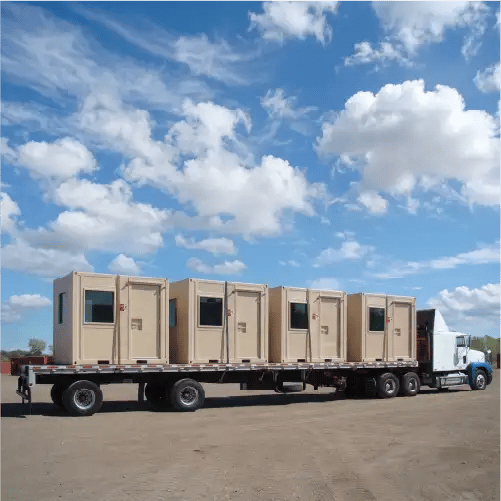 Transporting hardened modular facilities introduces constraints that must be considered during engineering, particularly when protective construction increases the weight of individual modules. Dimensions, weight distribution, lifting points, and structural connections can affect how a facility is transported and handled. These considerations may influence whether a project uses fully assembled modules, multiple connected units, or panelized construction.
For CONUS deployments, transportation planning typically involves highway regulations, oversize or overweight permits, route restrictions, and access to the installation site. OCONUS projects may also require ocean freight and port handling. Foreign destinations can add customs documentation and coordination with local authorities. Road conditions, bridge capacities, and the availability of suitable transport equipment can further influence delivery planning, particularly in remote locations.
Panelized construction and multiple connected modules offer different options for transportation and assembly. The appropriate configuration depends on module dimensions and weights, route and site access, lifting equipment, and the amount of field assembly required. Evaluating these constraints before fabrication helps reduce the risk of delivery problems or unplanned modifications.
Delivery to the destination is only one part of a successful modular deployment. Site conditions, foundation readiness, available equipment, and coordination with local personnel determine how efficiently a hardened facility can be installed and placed into service. These requirements should be established during project planning rather than addressed after the modules arrive.
Foundation and anchoring designs must account for the facility's structural loads, applicable environmental forces, and site-specific geotechnical conditions. Installation planning also requires adequate access for transport vehicles and lifting equipment, sufficient working space, and a clear understanding of how modules will be positioned and connected. For multi-module facilities, alignment, structural connections, weatherproofing, and the integration of building systems may require additional field coordination.
Infrastructure availability is another important consideration. Electrical service, communications connections, drainage, and other utilities may already be available at an established installation, while a remote site may require additional preparation. Electrical systems must also be coordinated with the available power supply. These challenges affect both CONUS and OCONUS projects. Confirming site readiness, equipment availability, and responsibility for unloading, installation, utility connections and final testing before shipment all help reduce delays.
Early coordination among engineers, manufacturers, transportation providers, and installation contractors helps address the constraints that can affect a CONUS or OCONUS deployment. Protective specifications, environmental conditions, transportation limits, and site readiness should be considered together before fabrication begins.
CoverSix's experience across multiple geographic regions and mission types informs this planning process. Defining deployment requirements and installation responsibilities early helps customers establish a practical scope and schedule for their facility.
Planning a hardened modular facility for a CONUS or OCONUS deployment? Contact CoverSix to discuss your mission requirements, site conditions, and project objectives.